What Mr. Blackburn Treats
Mr. Blackburn sees patients with a wide variety of skin lesions and subcutaneous lumps. Most procedures are performed under local anaesthetic as a day case, with no overnight stay required.
Skin Lesion Excision
Skin lesions include a broad range of benign and potentially malignant growths on or just beneath the surface of the skin. Mr. Blackburn assesses each lesion clinically and, where removal is indicated, plans the excision carefully, taking into account the site, size, likely diagnosis and the need for clear margins.
Incision orientation is planned along natural skin tension lines to minimise the resulting scar. Closure is performed in layers, with fine sutures placed to achieve the neatest possible result. Wherever possible, dissolving sutures are used, removing the need for a suture removal appointment. On the face, non-dissolving sutures are used to allow the finest possible control over wound closure. All excised tissue is routinely sent for histological examination.
- Moles (benign naevi): cosmetic removal or clinical concern
- Seborrhoeic keratoses and viral warts
- Epidermoid (sebaceous) cysts
- Basal cell carcinoma (BCC) and squamous cell carcinoma (SCC)
- Dermatofibroma, pyogenic granuloma and other benign lesions
- Scar revision following previous excision
Case in Focus: BCC Excision, Décolletage
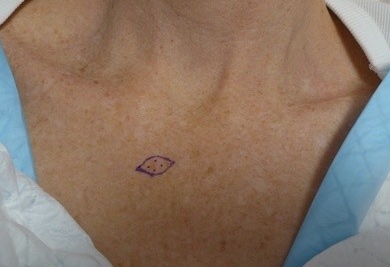
Surgical markings for complete BCC excision as a planned ellipse, oriented along natural skin tension lines of the décolletage.

Fine linear scar at 11 days post-operatively, prior to commencing scar management tape.

Tan 25 mm 3M Micropore tape in place. The tape prevents scar stretching, auto-moisturises using the skin's natural oils and shower dampness, and acts as a sunblock.
Published with written patient consent.
Lipoma Excision
Lipomas are benign fatty lumps that develop in the layer of tissue just beneath the skin. They are very common and rarely dangerous, but can cause discomfort, restriction of movement, or significant cosmetic concern, particularly when they are large, prominent, or located on the face, neck or limbs.
Mr. Blackburn excises lipomas through a carefully planned incision, removing the fatty mass in its entirety to reduce the risk of recurrence. The incision is closed neatly in layers, and the resulting scar is typically far smaller than the original lump. Deeper or larger lipomas, including subfascial or intramuscular lipomas, can also be addressed where appropriate.
- Benign fatty lumps anywhere on the body
- Complete excision to minimise risk of recurrence
- Large, painful or cosmetically troublesome lipomas
- Deeper subfascial or intramuscular lipomas
- Multiple lipomas: staged or combined excision

Cyst Excision
Epidermoid cysts (commonly called sebaceous cysts) are benign sacs beneath the skin surface, typically filled with keratin. They can grow slowly over time, become inflamed or infected, and are often a source of significant cosmetic or physical discomfort. Simple aspiration is rarely curative; complete surgical excision of the cyst wall is required to prevent recurrence.
Mr. Blackburn excises cysts intact wherever possible, removing the entire capsule to minimise the chance of the cyst returning. Where a cyst has previously ruptured or become infected, surgery is planned carefully to deal with the scarring and inflammation this causes.
- Epidermoid (sebaceous) cysts on face, scalp, trunk or limbs
- Pilar cysts of the scalp
- Complete capsule removal to prevent recurrence
- Infected or previously ruptured cysts managed carefully